Backpackers are more than visitors. They’re an important part of Australia’s tourism workforce.
Proposed visa changes could mean fewer Working Holiday Makers travelling and working across Australia, making it even harder for tourism businesses to fill critical roles, particularly during regional and seasonal peaks.
Industry is calling on the Australian Government to protect Working Holiday Maker visas.
If backpackers matter to your business or community, add your voice and sign the petition HERE
MEDIA RELEASE | 5AM AEST 10 September 2026 | Australian Tourism Industry Council (ATIC)
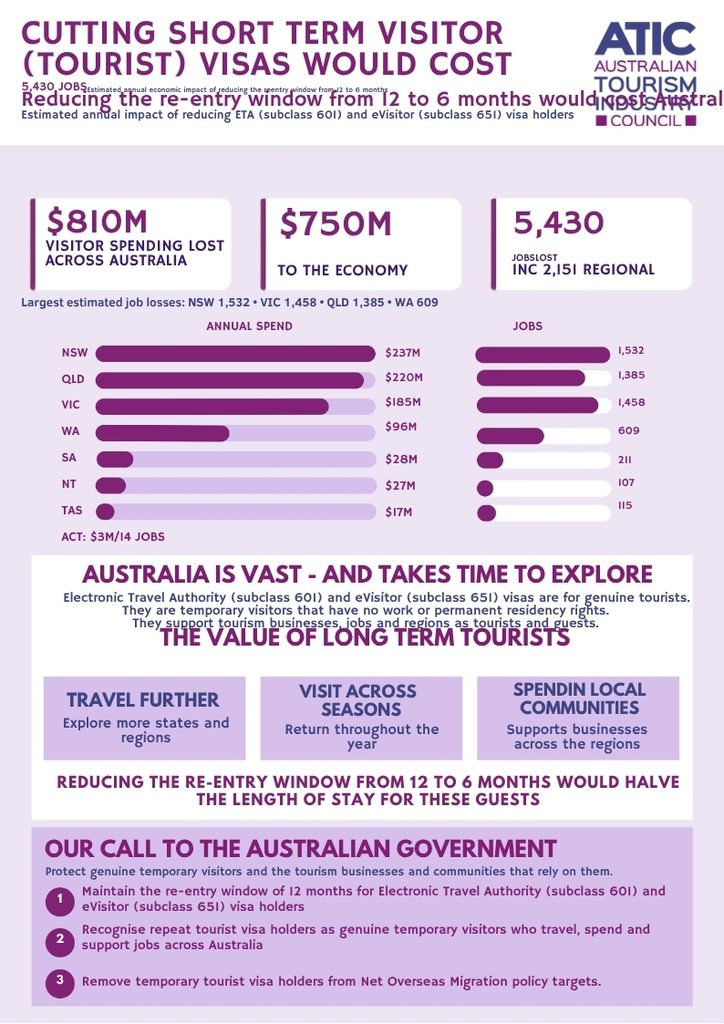
The Australian Tourism Industry Council (ATIC) has raised serious concerns over reports that the Australian Government will cap longer stay tourists from travelling and working across regional Australia. Longer-stay tourists who spend more than 12 months in Australia on an eVisa or Working Holiday Maker are officially counted as “migrants”, even though they are temporary visas that do not allow permanent residency and must ultimately leave Australia.
Proposed changes to tourist visas such as Working Holiday Maker (Backpacker) and eVisas in order to lower the official headline Net Overseas Migration figure would put an estimated 20,250 jobs at risk and cost the Australian economy $3.04 billion in lost visitor spending each year, according to new modelling from the Australian Tourism Industry Council (ATIC).
“Cutting longer stay tourists would cost 20,250 jobs across Australians tourism industry and regional communities,” ATIC CEO Erin McLeod said.
“Backpackers are tourists not migrants, they are big spenders in our communities and help fill critical, seasonal labour shortages. They are often the backbone of local regional economies.”
“Recent polling shows two-thirds of Australians do not personally consider backpackers or tourists on temporary visas to be migrants, while 80 per cent consider Working Holiday Makers an important source of workers for Australian businesses.” Ms McLeod said.
A recent online survey conducted in the first week of September by the Australian Tourism Industry Council with over 1,000 Australian respondents showed strong support for longer stay, temporary eVisa and Working Holiday Maker tourists. The survey clearly showed Australians do not consider longer stay, temporary tourists visa holders to be migrants.
“Australians understand the value that backpackers and other international tourists bring. They do not want regional businesses and jobs sacrificed simply to reduce the official headline migration number.
Tourists need more than 12 months to travel across multiple states, regions and seasons. These top spending tourists support accommodation providers, hospitality businesses, tours, attractions, transport operators, retailers and other local services, particularly in regional destinations.
“Longer-stay tourists are not permanent migrants. They are temporary visitors who travel widely across Australia, spending in our communities before returning home.” Ms McLeod said.
From working on whale-watching tours and ski fields to pouring beers, staffing events and supporting seasonal harvests, backpackers have long filled critical roles in areas with significant labour shortages. Their contribution allows businesses to remain open and continue providing experiences and services to local communities and other visitors.
“Without enough workers, tourism, hospitality and other regional businesses could be forced to reduce operating hours, cut services or in some cases, close altogether,” Ms McLeod said.
“Regional communities stand to lose twice: first through the loss of valuable tourist dollars, and again through the loss of an important seasonal backpacker workforce. The broader impact on regional economies would be significantly greater than these figures show.”
“We are asking the Government to exclude tourists from net overseas migration figures and retain the regional travel, visitor spending and economic contribution generated by long-stay visitors,” Ms McLeod said.
Related Media Release: Working Holiday Makers are solving problems, not creating them